05 · ENERGY STORAGE
Commercial BESS for GDMTH operations
Store energy. Control demand. Protect operations.
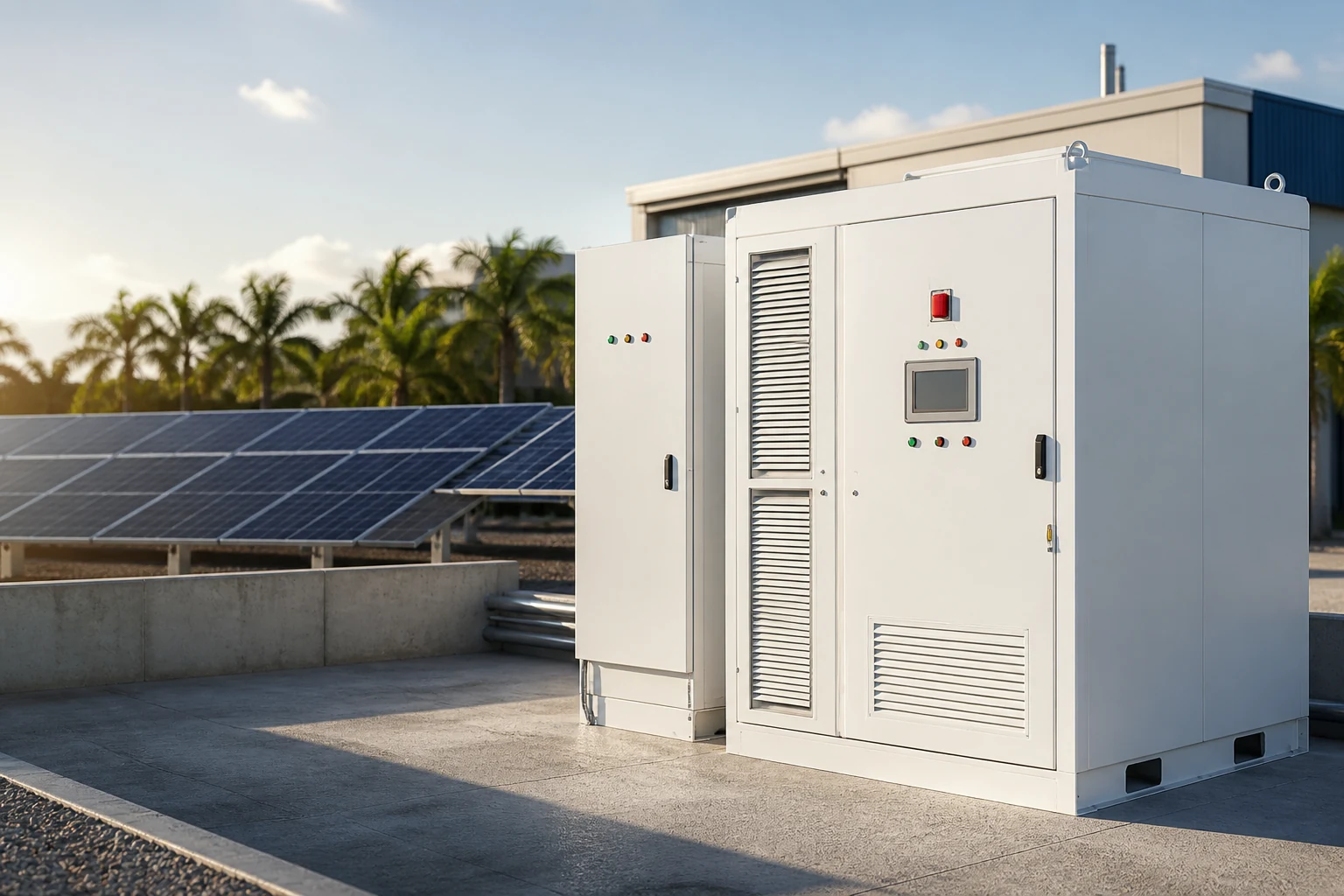
Commercial and industrial battery storage engineered around each site's GDMTH load profile, operating priorities, solar potential and expansion plan, with Canadian Solar KuBank 2.0 as a principal reference platform.
Discuss this solution CAPABILITY
Commercial BESS for GDMTH operations
STORAGE WITH AN OPERATING PURPOSE
Store at the right time.
Use energy with intent.
A BESS is most valuable when its operating strategy is engineered around the facility. We connect load behavior, solar production, tariff exposure and continuity priorities to a practical power-and-energy configuration.
Control peaks
Discharge during high-demand periods to support demand management and reduce avoidable power peaks.
Use more solar
Shift surplus photovoltaic production into later operating hours instead of leaving useful energy stranded.
Plan resilience
Prioritize selected loads and define a project-specific backup strategy around actual operational risks.
Expand in phases
Build a modular pathway that can follow future load, solar-generation or electrification requirements.
277 kWhReference unit energy
125 kVAReference rated power
2HReference duration
LFPLiquid-cooled architecture
SOLAR-FIRST ENERGY ARCHITECTURE
Generate more.
Store intelligently.
Control demand.
We first evaluate how much useful photovoltaic generation can be created on rooftops and parking areas. The BESS and EMS are then engineered to coordinate that generation with the GDMTH demand profile, facility loads and selected resilience priorities.
Explore GDMTH applications ↗ROOFTOP PV+SPCP SOLAR CARPORTS→EMS + BESS→FACILITY + PRIORITIZED LOADSGRID, GENERATOR AND PROTECTION COORDINATION ARE ENGINEERED FOR EACH SITE
ONE MODULAR CONCEPT · MULTIPLE SCALES
From a 1.5 MVA reference point
to larger engineered systems.
Modular capacity can be expanded, but the right system begins with the site's load and operating case. These values are reference points—not pre-approved configurations.
Current hospitality reference
Illustrative expansion point
Illustrative expansion point
ENGINEERED REFERENCE · HOSPITALITY
View the anonymous reference 1.5 MVA / 3.324 MWh
A solar-ready BESS architecture developed around the operating profile of a large hospitality property under GDMTH.
STATUS · COMMERCIAL PROJECT UNDER CLIENT REVIEW ENGINEERED ENERGY STORAGE
From the load profile.
To a controlled asset.
Storage capacity alone does not define a successful project. Soluxion Verde develops the operating case, electrical integration, control logic, safety approach and commissioning plan as one coordinated system.
REFERENCE TECHNOLOGYCanadian Solar KuBank 2.0
The 277 kWh, 125 kVA, two-hour reference unit uses liquid-cooled LFP architecture with modular parallel expansion, layered detection and emergency-shutdown functions. Final equipment and configuration remain project-specific.
Analyze
Review interval data, demand peaks, critical loads, solar production and operating schedules.
Model
Compare power, energy, dispatch and economic scenarios against the site's real objectives.
Engineer
Define electrical interfaces, protections, controls, communications and physical placement.
Deploy
Coordinate equipment, construction, testing and commissioning around an active facility.
Operate
Establish the dispatch strategy, performance visibility and a pathway for future expansion.
Usable energy, power, backup duration, savings, peak reduction and safety requirements depend on the engineered configuration, load profile, operating strategy, site conditions, applicable codes and manufacturer documentation. A reference rating is not a performance guarantee for every project.
NEXT SOLUTION
Continue exploring